Saturday, 9 October 2021

St. Catharines - Watson Monument


Location:  Niagara Region     N 43.15973   W -79.24697

On the front lawn of the City Hall, corner of James and Church Streets.


This memorial is very controversial at the current time and situation that we find ourselves in.  I will give a link for you to read more of this intolerable situation for which all of St. Catharines should be ashamed.  Local government and "community stakeholders" would like to have this monument removed for reasons that are beyond comprehension.  Read more here:  https://www.iheartradio.ca/610cktb/news/future-of-private-watson-statue-still-unknown-1.16211354?fbclid=IwAR2w_O4DXPVv-OOYvL5nDJ78ajsMYpc5LLKzN1sD-_VsxAwyvoFdWN8b1W8
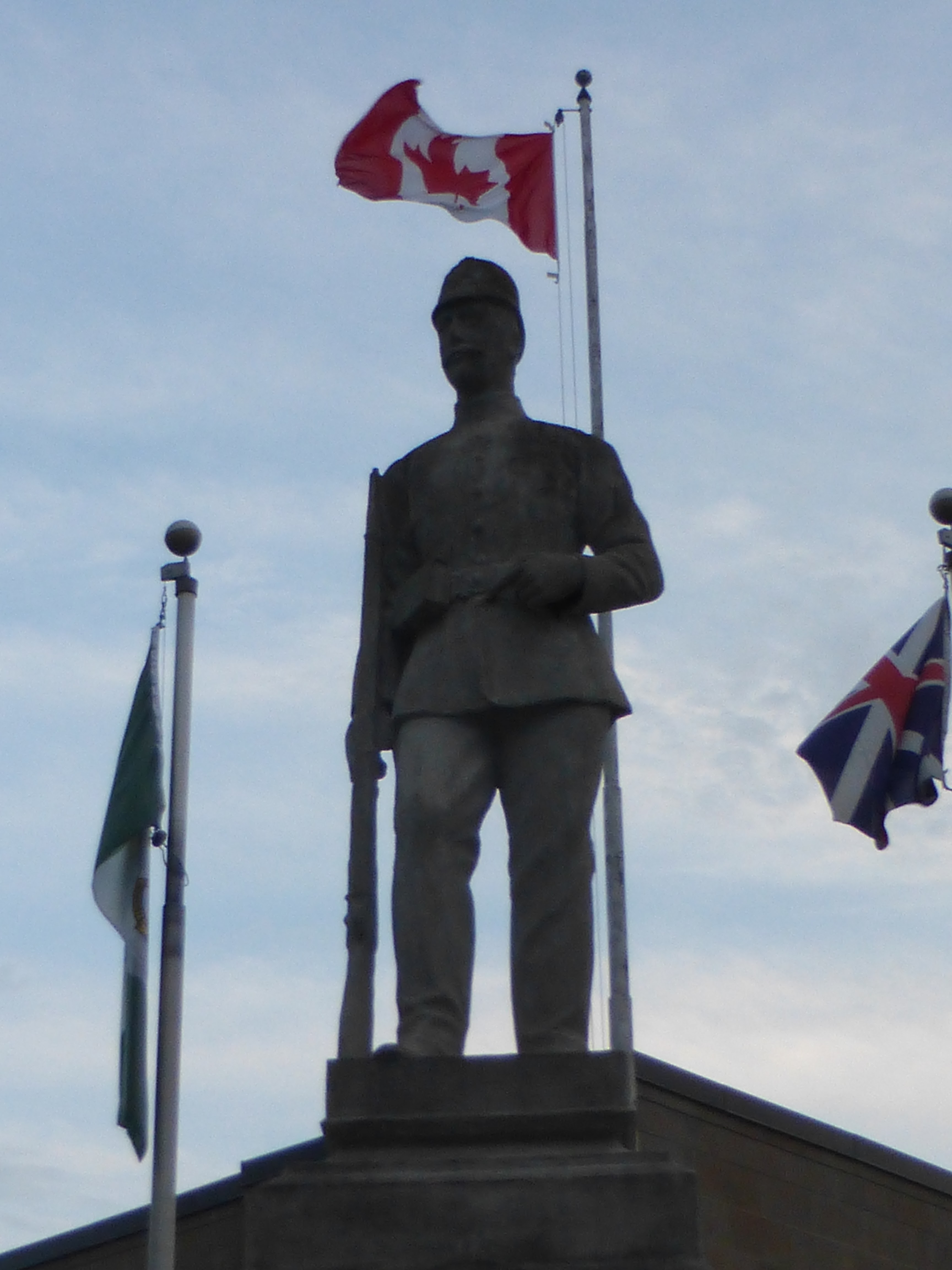
Now onto the memorial itself and the reason for why it was erected at the time.   The following is taken from the Veterans Canada website:

"The Watson Monument was erected by the people of St. Catharines in 1886 to the memory of Private Alexander Watson, XC Winnipeg Battalion Riffles, Canadian Volunteers, and his companions in arms, who fell in battle during the Riel Rebellion in the Northwest Territories, A.D., 1885.

The monument was erected by the people of St. Catharines, where Watson and his family were long resident and highly esteemed. It stands on the City Hall green, is about fifteen feet high, and consists of a soldier, in full uniform, of the 90th Winnipeg Riffles, standing on a pedestal, each face of which is adorned with trophies. It was built by James Munro's Marble and Granite Works of St. Catharines, Ontario.

From the Thorold Post, Friday, August 13, 1886:

Watson Monument - City Council has a special meeting and granted permission to the Watson Monument Memorial Committee to place the monument on the grounds in front of the City Buildings. The original intention was to have it in the cemetery.

From the Thorold Post, Friday, September 17, 1886:

Unveiling of the Watson monument was Tuesday afternoon between 3 and 4 p.m., largest crowd ever seen in one city, (were on the fences, etc.) hundreds were there.

From the Thorold Post, Friday, September 17, 1886:

Watson monument was unveiled "last Tuesday". The article says it represents a Canadian volunteer in the "at ease" position. The deed was handed over to Mayor King from the Monument Committee. Major General F.D. Middleton, C.B., unveiled the statue.

Note: The Thorold Post, Friday, August 13th, 1886 edition supplies additional details about the location. From the North West Rebellion, C.P. Mulvaney, M.A.: Private Watson Private Alexander Watson, F.Co., 90th (Winnipeg) Battalion, who was wounded on the last day of the fight at Batoche, and died the following Saturday, was born in Toronto in 1858, but lived in St. Catharines the greater part of his life till about four years before the rebellion, when he moved to Winnipeg. While in Winnipeg he was in the employ of a contractor and builder, he having been brought up to that business in St. Catharines. He was the eldest son, but had an elder sister. Personally he was a generous, kind-hearted young man and a great favourite with everyone. He was unmarried, but was shortly to have led to the altar a very estimable young lady of Winnipeg."


Market text:

Front:

ERECTED TO THE MEMORY OF

PRIVATE ALEXANDER WATSON

90TH WINNIPEG BATT. RIFLES 

CANADIAN VOLUNTEERS,

AND HIS COMPANIONS IN ARMS,

WHO FELL IN BATTLE DURING

THE REBELLION OF THE N.W.T.

A.D. 1885


'Dulce et decorum est pro patria mori."

LT.-COL. A.T.H. WILLIAMS

BATTLEFIELD RIFLES, N.W.M. POLICE

CORP. W.H.T. LOWRY

R.B. SLEISH     CONST. P. BURKE


Right side:

BOULTON'S SCOUTS

Capt. E.L. Brown, J. French, Intelligence Corps.,

AT DUCK LAKE, FISH CREEK, CUT KNIFE, BATOCHE;


W. Cook, W. Phillips, C.Co., I.S.C.;


Private J. Watson, Bugler H. Foulkes, G.G.F. Guards;


Private J. Rogers, Private Osgood,

10th ROYAL GRENADIERS;


Lieut. W. Fitch,  Private T. Moore,

90th BATTL'N RIFLES;


Lieut. C. Swinford, Corp. J. Code,

Private A.W. Ferguson, J. Hutchinson,

W. Ennis, R.R. Hardisty, J. Fraser, G. Wheeler,

Private T.H. Damanolley, Lieut. A.W. Keppen.


Left side:

Major Henry M. Arnold,

90th WINNIPEG RIFLES,

CAPT. 2nd SPECIAL SERVICE BATTALION, R.C.R.I.,

died Feb. 23rd. 1900, from wounds received in action at

Paardburg Drift, South Africa, Feb. 18th. 1900.


Lieut, J. Edgar Burch,

ADJT. 2nd DRAGOONS, attached to  1st BATTALION C.M.R.,

on special duty, killed in action near Pretoria,

South Africa, July 16th. 1900.


Private Archibald Radcliffe,

1st. BATTALION C.M.R., 2d TROOP, A. SQUADRON,

FIELD FORCE, SOUTH AFRICA,

killed near Belfast, S.A., Sept. 23rd. 1900.


Corp. Robert Irwin,

19th ST. CATHARINES REGIMENT,

wounded at Houtuck, South Africa, May 1st. 1900,

died in Bloemfontein, S.A., July 1st. 1900.


Sunday, 3 October 2021

Deep River


Location: Renfrew County

GPS: N 46.100757 - W 77.487829


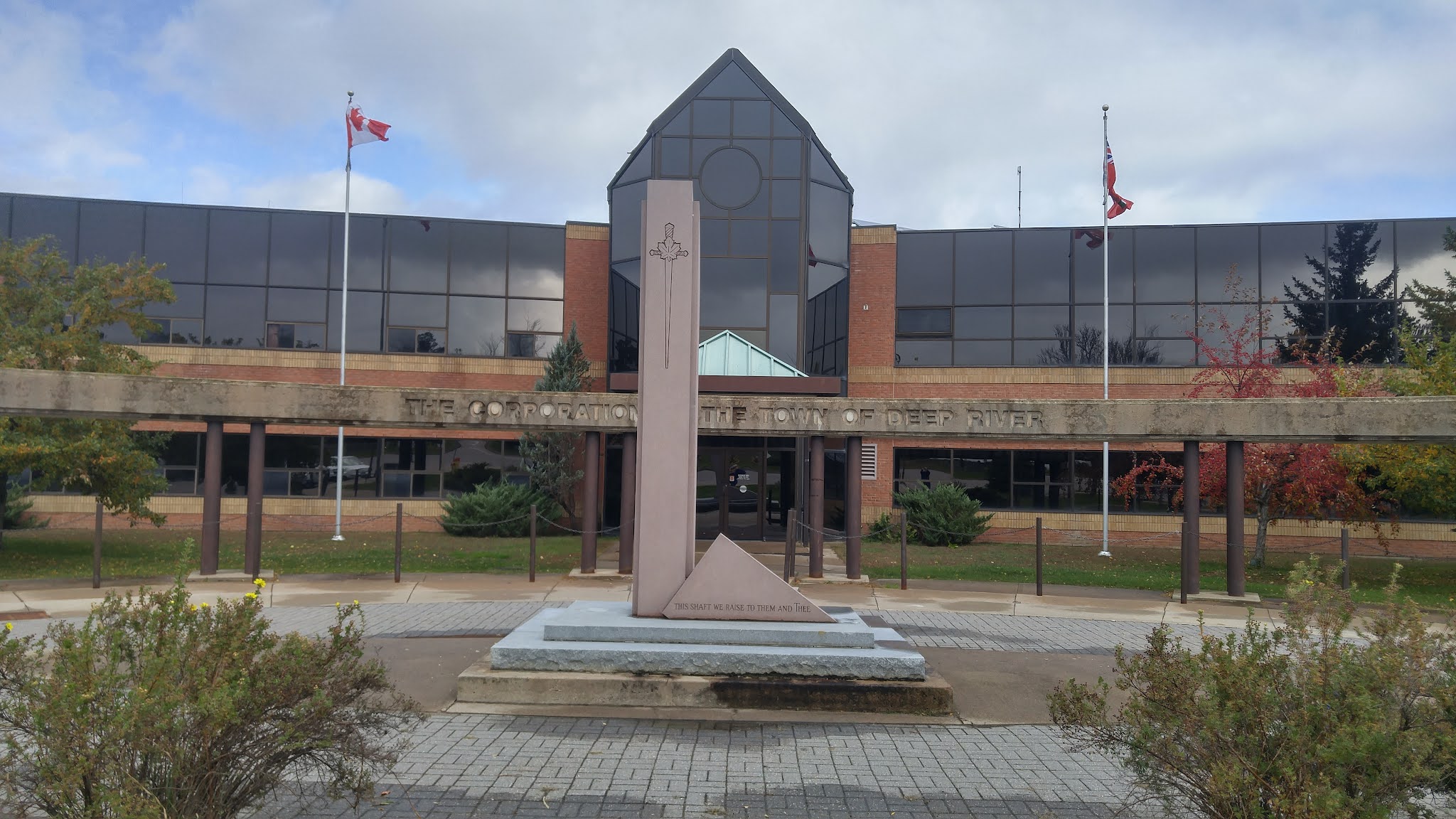
This cenotaph is situated in front of The Corporation of the Town of Deep River (town hall) at 100 Deep River Rd.


When passing in front, seeing this modern style sculpture, you would never guess that this would be a cenotaph, until you get closer and see the sword engraved on it. And getting closer seeing the inscription and reading it.


This cenotaph was dedicated around 1990 about the same time the building was built. Every year there is a ceremony on Remembrance Day. It is dedicated to all our soldiers of all wars.


On the shaft of the sculpture there is a sword pointed down nicely decorated by a maple leaf. In front of the shaft, on the right there is a triangular shape sculpture with an inscription on it.


*Thanks to Louise Bellec for the photos and description.


Inscription:    THIS SHAFT WE RAISE TO THEM AND THEE


Sunday, 26 September 2021

St. Isadore


Location:  Prescott and Russell Counties     N 45.38668   W -74.90207

In front of the library, at 25 De l'Arena Street.

St. Isadore is a bilingual community of 750 people in the eastern part of Ontario.  Sadly, the large church which was the dominating feature of the town, was destroyed by fire in 2016. The memorial is found in a nicely landscaped area in front of the library.  It is worded in French and provides a detailed legend to accompany the list of names of the fallen heroes from this small community.  The legend indicates which branch of the service and which war each of the names is to be associated with, a rather unique feature seldom found on other memorials.  The crests of each branch of the Canadian Forces, along with a strange globe is also engraved in the grey granite memorial.  In front of the main memorial is an old limestone marker, presumably the original memorial with names of those who served.  Also, nearby is a beautiful mural painted on a building wall.


***Photos by Louise Bellec.

Marker text:

LEGENDE

A (ARMEE)

B (ARC) AVIATION ROYALE DU CANADA

C (MARINE)

t (AUMONIER)

I (PREMIERE GUERRE 1914-1918)

II (DEUXIEME GUERRE 1939-1945)

# (GUERRE DE COREE 1950-1953)

* (DECEDE AU COMBAT)


BERGEVIN EMILE  AII

BOULANGER WILFRID  AII

BOURGON BERNARD  AII

CAMPEAU GASPARD  AI

CAMPEAU HENRI  AII

CHARTRAND LEO  AII

CHARTRAND ROLLAND ABII

CHARTRAND THEODORE  II

CLEMENT ROCH  ABII

GALIPEAU LAURENT  A#

GALIPEAU RAYMOND  AII

LALONDE JEAN  AII

LAUZON FERNAND  AII

LEGAULT ALBAN  tA#

LEGAULT ARTHUR  AI

LEROUX ARCADE  AII

MEILLEUR FERNAND  ABII

PILON REGINALD  AII

POIRIER HENRI  AII

SABOURIN JEAN-PAUL  BII*


Old Stone:

JEAN-PAUL SABOURIN  D.F.C.

L.T. DE SECTION

MORT

AU CHAMP D'HONNEUR


OUTRE-MER

WILFRID BOULANGER

BERNARD BOURGON

HENRI CAMPEAU

LEO CHARTRAND

ROLLAND CHARTRAND

THEODORE CHARTRAND

FERNAND LAUZON

ARCADE LEROUX

C.L.A. FERNAND MEILLEUR


ACTIFS

EMILE BERGEVIN

ROCH CLEMENT

RAYMOND GALIPEAU

SERGENT JEAN LALONDE

REGINALD PILON 

HENRI POIRIER


Sunday, 19 September 2021

St. Helens


Location:  Huron County     N 43.90272   W -81.51005

At the corner of Belfast Road and St. Helens Line, beside the community centre.


 St. Helens is a quiet rural crossroads in the heart of a Mennonite farming community.

This memorial is best described from the following article in the Signal Star, written by David Yates and published in August 2020. 

"On Nov. 11, 1918, John Joynt, a wealthy Huron County farmer and entrepreneur, was lying in a Buffalo, New York hospital recovering from the Spanish influenza when he awoke to bells ringing and horns blowing.  He knew that the noise heralded news that the War To End All Wars had arrived.

Tracker ..

Joynt was born in Mayo County, Ireland in November 1854. He was the oldest of eight children born to John and Ellen Joynt, Irish Protestants who immigrated to Canada about 1865.

After initially settling in Durham County, the Joynt family removed to West Wawanosh where they were well established by the 1881 census.

John Jr. married Annie Amelia Fulford of Teeswater in September 1882 and together they had four daughters. Joynt went into farming but as a bright and ambitious young man he branched out into potash production, apple growing and operated apple evaporator plants in Lucknow, Teeswater and Walkerton.

With a lucrative trade in exporting hardwoods and fruit, Joynt had risen from his impoverished background to become a truly self-made man.

By 1919 when Joynt was elected to the provincial legislature as the Conservative member in North Huron, he owned 1,400 acres of land and was one of the most prosperous men in the county.

Too old to serve in the war and having only daughters, Joynt wanted “to do something for the boys of Huron,” according to the Goderich Star.

At his own expense, he spent the then-considerable sum of $5,000 on a monument to honour those from West Wawanosh who had served in the Great War. 

The Joynt War Memorial was the only cenotaph in Huron County paid for entirely by a private individual.

He chose the St. Helens crossroads to erect a monument because whenever he returned to St. Helens “he always thought of his mother and her inspiration and he considered this [St. Helens] the most suitable place for the erection of a monument in appreciation of the deeds of others,” the Star reported.

Indeed, in 1922, Joynt had donated the site and moved the St. Helens community centre to the northeast corner of the crossroads where he intended to place the war memorial.

On May 24, 1923, Victoria Day, “all roads led to St, Helens,” according to the Wingham Advance. Between 3,000 and 4,000 people gathered for the unveiling ceremony of Joynt’s memorial. It was the largest gathering ever held before or since at St. Helens. The impressive ceremony began with a platoon of Great War veterans marching to the flag-draped monument halting and firing three volleys into the air followed by a bugler sounding the “Last Post” before a crowd of thousands who doffed their caps.

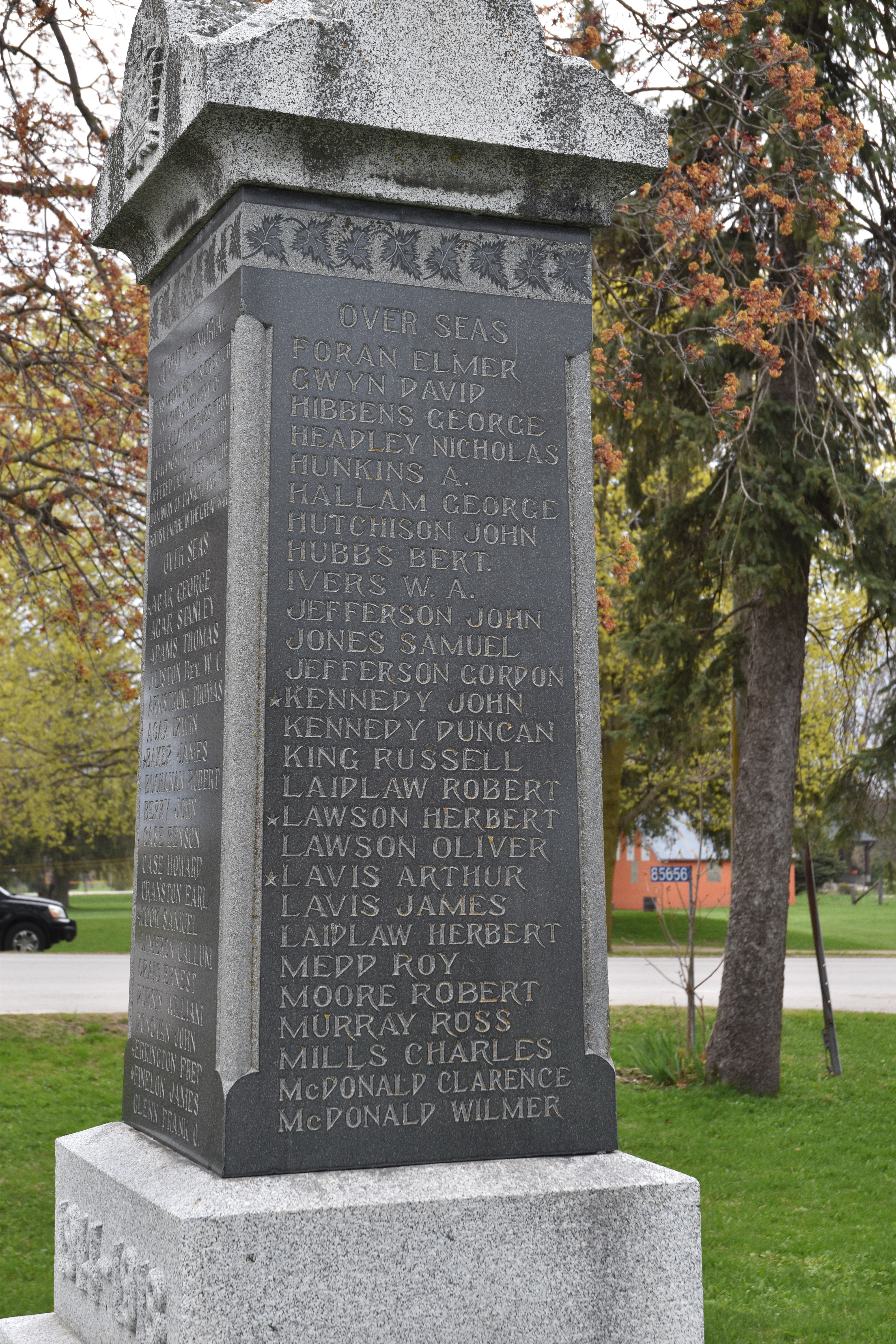
Lieut-Colonel H B Combe, former commander of the 161st Huron Battalion, drew the Union Jack off of the black granite monument revealing the names of the West Wawanosh men who had served in the Great War.

Seven “little girls in white” placed floral bouquets on the monument. Each bouquet represented the name of a West Wawanosh soldier who fell in battle. For those in attendance who knew fallen, the cenotaph’s unveiling ceremony was a proxy funeral for those who lie buried in a foreign grave.

Some idea of the tremendous impact that the Great War had on remote and rural areas like West Wawanosh is that 87 names of local men are engraved on the monument of those who wore their country’s uniform.

Local historian Rhea Hamilton Seeger notes that further research has turned up even more West Wawanosh names not listed on the monument.

Immediately after Joynt formally handed the monument over to West Wawanosh, Reeve B S Naylor, Lieut-Colonel Dougall Carmichael, a highly-decorated war hero, lauded the valour of Canadians in the Great War calling them “the finest body of fighting men who ever lived.”

Carmichael remarked that the “monuments scattered throughout the country help us bear in mind all the sacrifices, all the sorrows” and, further, hoped “we would never fail to appreciate what these great men did.”

After the speeches, appropriate music was provided by the Lucknow Pipe Band, Lucknow Boy Scouts Band and the Wingham Brass Band. The program closed with over 3,000 voices singing “God Save the King.”

The Women’s Institute who had done so much in supporting the local war effort accomplished the near impossible by providing sandwiches and lemonade for the multitudes.

The Advance disclosed that 600 loaves of bread were purchased for the occasion and that “every person was fed.”

Undoubtedly, the Joynt Memorial’s unveiling was the profoundly solemn spectacle in West Wawanosh’s history.

Yet, there were those who criticized the Joynt Memorial as a cynical political ploy to help buy votes. The Wingham Advance defended Joynt by observing that “judging by the crowd of people present at the unveiling we think the people who appreciate Mr Joynt’s philanthropy are very much in the majority.” 

Six more names were added after the Second World War.

After the demolition of the St. Helens United Church in 1978, a bell with the names of men who had fought and died in the Great War was placed beside the monument notes the township history book Reflections of West Wowanosh (1995).

After serving two terms in the provincial legislature, John Joynt declined to run for re-election in 1926. He died in December 1937.

He was eulogized as one who had “achieved high standing in his community and his integrity, not less than his business acumen.”

The West Wawanosh Soldiers’ Monument, also known as the Joynt Memorial, eternally bears witness to the courage of a small community at the St. Helens crossroads."


Marker text:

Cenotaph Front:

JOYNT MEMORIAL

THIS MONUMENT IS ERECTED 

IN LOVING MEMORY OF

THE GALLANT HEROES FROM

WAWANOSH TOWNSHIP WHO

OFFERED THEIR LIVES FOR THE

DOMINION OF CANADA AND THE 

BRITISH EMPIRE IN THE GREAT WAR


OVERSEAS

*AGAR GEORGE

AGAR STANLEY

ADAMS THOMAS

ALISTON REV. W.C.

ARMSTRONG THOMAS

AGAR IRWIN

*BAKER JAMES

BUCHANAN ROBERT

BERRY JOHN

CASE BENSON

CASE HOWARD

CRANSTON EARL

*COOK SAMUEL

CAMERON CALLUM

CRAIG ERNEST

DURNIN WILLIAM

DONOVAN JOHN

*ERRINGTON FRED

*FINELON JAMES

GLENN FRANK O.


1914 - 1918


Right side:

OVERSEAS

FORAN ELMER

GWYN DAVID

HIBBENS GEORGE

HEADLEY NICHOLAS

HUNKINS A.

HALLAM GEORGE

HUTCHINSON JOHN

HUBBS BERT

IVERS W.A.

JEFFERSON JOHN

JONES SAMUEL

JEFFERSON GORDON

*KENNEDY JOHN

KENNEDY DUNCAN

KING RUSSELL

LAIDLAW ROBERT

*LAWSON HERBERT

LAWSON OLIVER

*LAVIS ARTHUR

LAVIS JAMES

LAIDLAW HERBERT

MEDD ROY

MOORE ROBERT

MURRAY ROSS

MILLS CHARLES

McDONALD CLARENCE

McDONALD WILMER


Left side:

OVERSEAS

McGUIRE ROBERT

NEWMAN ARTHUR

NEVINS CHARLES

NEIL ERNEST

ORSER FRANK

ORCHARD CECIL

PATTERSON JAMES

PATTERSON ARCHIE

PENTLAND HAROLD G.

PLOWMAN THOMAS

RUTLEDGE GORDON

RIVERS BERT

ROBERTSON ROBERTS

ROLLINSON ALFRED

SPROUL HAROLD L.

STALKER ROY

STALKER JOHN

STUART JOSEPH

SYMINGTON CLARENCE H.

SMYLE WILLIAM

TAYLOR JOHN

THOMPSON JOSEPH

THOMPSON ERNEST

WILSON WILLIAM H.

WILSON EARL

WILSON ROBERT


Back:

IN TRAINING IN CANADA

PHILLIPS ROBERT

JEFFERSON CHARLES

THOMPSON JOHN R.

JOHNSTON VICTOR

SMYTH WILLIAM J.

MONK WESLEY

ANDERSON JARVIS

ANDERSON LINFIELD

DURNIN JOHN

WEBSTER ELLWELL

NEWMAN FRED

WELLWOOD JOHN

SOMERVILLE ROBERT


IN GRATEFUL TRIBUTE

2ND WORLD WAR

1939 - 1945

BOWERS WILLIAM

HOUSTON JAMES

IRWIN HAROLD

MAGOFFIN IVAN

McQUILLAN GEORGE

MONTGOMERY ROBERT


Bell Front:

MENEELY & CO., WATERVLIET, N.Y. 1919


IN LOVING MEMORY OF THOSE WHO FOUGHT

AND THOSE WHO DIED FOR FREEDOM

1914   1918

EARL CRANSTON      SAM JONES

ARTHUR LAVIS           JOHN BERRY

M.C. CAMERON          JOHN TAYLOR

ROBT. McQUIRE          J.R. STUART

R. ROSS MURRAY       JAS. D. BAKER

R.D. BUCHANAN         JAMES LAVIS

R.H. ROBINSON           ROBT. J. WOODS


Back:

TO JAMES AITCHESON , SR.

IN APPRECIATION OF HIS

EFFORTS AND ZEAL, THIS

BELL WAS ERECTED 1919.