Sunday, 13 February 2022

Etobicoke - Toronto Scottish


Location:  City of Toronto     N 43.60430   W -79.50218

70 Birmingham Street, in front of the armoury.
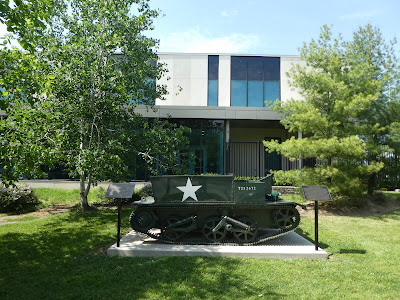
 

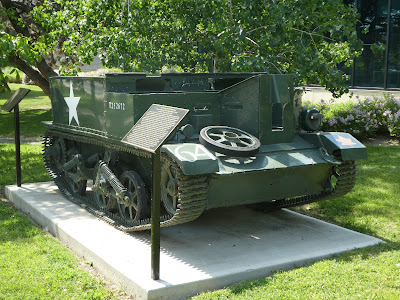
This memorial is a dedicated to the Toronto Scottish Regiment and is found in front of their home, the Captain Bellenden Hutcheson, VC Armoury.  The memorial consists of restored Universal "Bren Gun" Carrier from World War II, and two plaques which tell the story of the Regiment and its battle honours.

The Toronto Scottish Regiment is a Primary Reserve infantry regiment with companies in Etobicoke and Mississauga.

As the Army’s primary war-fighters and the core of the combat arms team, infantry soldiers are responsible for closing with and destroying the enemy. Supported by the artillery, regiments of armour and the combat engineers, infantry soldiers are capable of operating anywhere in the world in any environment - arctic tundra, mountains, jungle or desert - and in any combination of arms, including airmobile and amphibious operations.

The following plaques tell their story:


Marker text:

The Toronto Scottish Regiment (M.G.) Monument

During the Second World War, the regiment mobilized a machine gun (M.G.) battalion

for the 1st Canadian Division.  Following a reorganization in 1940, the battalion

was reassigned to the 2nd Canadian Division, where it operated as a Support Battalion,

providing machine-gun detachments for Operation Jubilee, the raid on Dieppe, France

in 1942.  With an additional company of heavy mortars, it operated in support of the

rifle battalions of the 2nd Division in Northwest Europe from July 1944 to VE Day.

Soldiers of the regiment also had the honour of mounting the King's Guard at

Buckingham Palace in April 1940.  Back in Canada a 2nd Battalion served in the

reserve army.  In 2000, the regiment added a second title in recognition of Her

Majesty The Queen Mother's long association a Colonel-in-Chief, a position she

had held since 1937.  The name of the regiment changed to

The Toronto Scottish Regiment (Queen Elizabeth The Queen other's Own).

This monument recognizes all Canadians from the Second World War era who deployed

overseas, sacrificed their lives, suffered physical or mental injury, or were the families

who supported our soldiers from the home front.  In addition, this monument recognizes

the role of the Canadian Armed Forces in the liberation of France, Belgium and The

Netherlands and the triumph of all that is good.  It was made possible with great

appreciation to The Toronto Scottish Regiment Foundation and Senate, Max Franzini

Family, Lieutenant-Colonel Garry Moore Family, Steve Ernewein Family, Michael Carlson

and Family, especially Honorary Colonel Helen Vari, C.M., CLH, OONM, LL.D, LHD,

and the George and Helen Vari Foundation and is dedicated to the

Honourable George W. Vari, P.C., C.M.


The Toronto Scottish Regiment

(Queen Elizabeth The Queen Mother's Own)

Universal "Bren Gun" Carrier.

Universal Carriers such as the one displayed on this monument were deployed

widely by Canada and British Commonwealth forces during the Second World War.

They were typically employed for transporting personnel, equipment and support

weapons, and were used as machine gun platforms for the .303 calibre Vickers

medium machine gun and the .303 calibre Bren Gun.  The Toronto Scottish Regiment

(Queens Elizabeth The Queen Mother's Own), a machine gun and support regiment of

the 2nd Canadian Division, 2nd Canadian Corps during the Second World War,

employed and relied heavily on these carriers.  They were an essential Allied

resource for the liberation of Northwest Europe against Nazi forces.

The Toronto Scottish Regiment (Queen Elizabeth The Queen Mother's Own), in the

beginning, was known as the 75th Battalion.  It was raided in 1915 when Lieutenant

Colonel SG Beckett undertook an assignment to recruit a battalion for the Canadian

Expeditionary Force.  The Battalion served in France and Belgium during the Great

War, winning a total of 16 Battle Honours.  Upon its arrival home in June 1919 the

75th Battalion was dismissed and on 1 September 1921 it was designated

The Toronto Scottish Regiment.  On 3 September 1939, two days after the Nazi forces

invaded Poland, The Canadian Government ordered the mobilization of units.

The Regiment was the first complete Canadian unit to land in the United Kingdom

during the Second World War.  With final victory,  the Regiment had earned

a total of 21 Battle Honours, and had suffered 425 casualties.


Saturday, 5 February 2022

Cobourg - Afghanistan Memorial


Location:  Northumberland County     N 43.97316   W -78.16068

In front of the St. John's Ambulance building, 700 D'Arcy Street.


The following is taken from the Veterans Affairs website:  https://www.veterans.gc.ca/eng/remembrance/memorials/national-inventory-canadian-memorials/details/10211

" Cobourg’s military history reveals that significant contingents of soldiers participated during the War of 1812, the First and Second World Wars and later it played a role in Canada’s post war defense plan by opening the No. 26 Central Ordnance Depot, in 1953. At capacity, the Depot employed over 700 military and civilian workers and stored over 30,000 items, such as, weapons, munitions and combat vehicles for development and testing. The Depot was later named Cobourg Forces Station in 1966 and is now the location of the Cobourg Afghanistan Memorial. The memorial was unveiled on November 8, 2019.

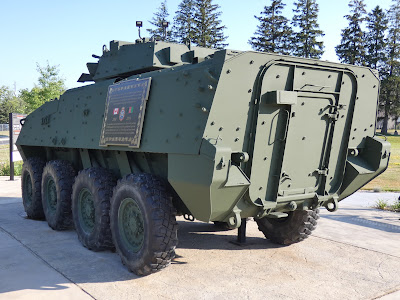
A LAV III monument is a permanent community symbol of remembrance which pays tribute to our Canadian Armed Forces who served and sacrificed in Afghanistan from 2001-2014. It is constructed from previously used LAV III hulls and remnant parts which have been decommission by the government. They are actual-size, look real, but are not functional. A LAV III is a Light Armoured Vehicle made of steel, supported by an 8-wheel drive suspension and powered by a 6-cylinder 350 horsepower diesel engine. It can weigh as much as 16,000 kg, carry various weapons, hold up to 10 passengers and reach speeds of 100 km/h.

The LAV III Monument Selection Committee, which is chaired by Major General (ret’d) David Fraser, a former Canadian Commander of Afghanistan South in 2006, along with other Afghanistan Veterans, award the Monuments while supplies last. This is a community sponsored monument. Each monument includes a commemorative plaque and costs $17,500, plus applicable sales tax. The original cost of an operational LAV III ranged from $1-4 Million depending upon the configuration. The LAV III is made by General Dynamics Land Systems Canada in London, Ontario, Canada.

The Town also dedicated the Ontario Street overpass to Captain Nichola Kathleen Sarah Goddard, who became the first female soldier killed, in 2006, during combat in Afghanistan."


In addition to the impressive LAV, there is also a stone with a large emblem of the Royal Canadian Ordnance Corps, who once operated out of this facility.  There is also a memorial stone and plaque dedicated to Major Michelle Knight Mendes, who died during her service in Afghanistan in 2009.

Cobourg is also the home of the Highway for Heroes movement that saw hundreds of local citizens lining the bridges of the 401 Highway during repatriation ceremonies, to pay their respects for those killed in the line of duty in Afghanistan.  A signboard display tells the story of Canada's role in Afghanistan.  


Marker text:

LAV:

IN RECOGNITION AND MEMORY OF THE EFFORTS OF APPROXIMATELY

40,000 CANADIAN ARMED FORCES PERSONNEL WHO SERVED AND

THE 162 CANADIANS WHO DIED IN THE CAUSE OF BRINGING PEACE

AND FREEDOM TO THE PEOPLE OF AFGHANISTAN.

2001     2014


RCOC plaque:

THIS BADGE IS DEDICATED TO

COMMEMORATE ALL MILITARY RANKS

OF THE

ROYAL CANADIAN ORDNANCE CORPS

WHO SERVED AT

26 CENTRAL ORDNANCE DEPOT


Major Mendes plaque:

IN HONOUR OF

MAJOR MICHELLE KNIGHT MENDES

CANADIAN ARMED FORCES INTELLIGENCE BRANCH

JULY 21, 1978 - APRIL 23, 2009 (AGED 30) 

KANDAHAR AIRFIELD BASE


COMMITTED TO A LIFE OF SERVING IN UNIFORM

"MIC" LIVED HER LIFE WITH PURPOSE AND WAS DETERMINED

TO MAKE A DIFFERENCE.


Sunday, 30 January 2022

Hamilton - Hamilton Cemetery


Location:  City of Hamilton     N 43.27104   N -79.88904

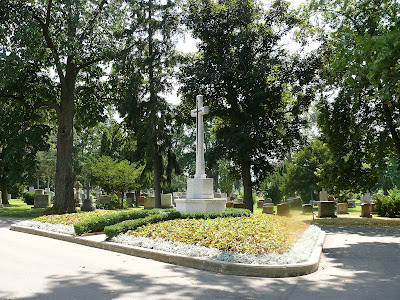
In the centre of Hamilton Cemetery, 777 York Boulevard.


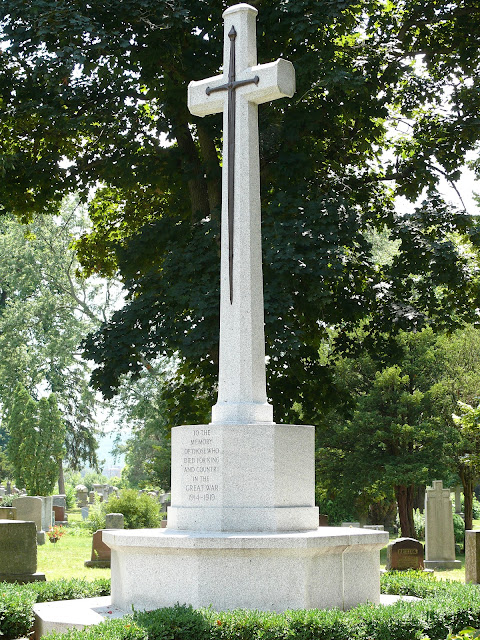
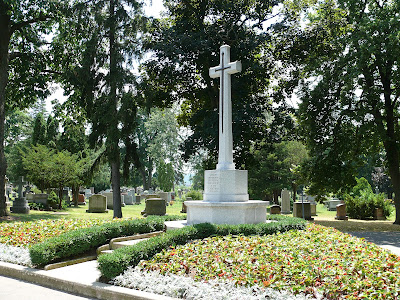
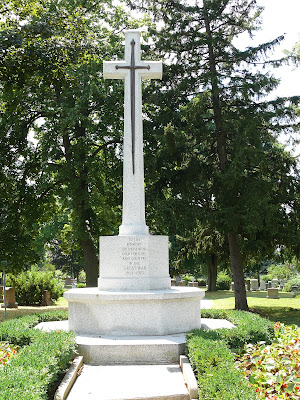
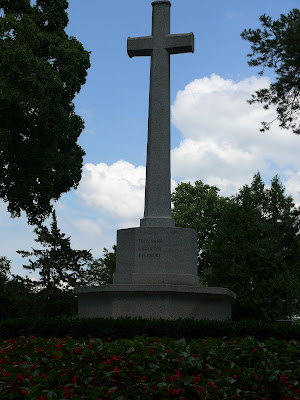
This memorial, known as the "Cross of Sacrifice" stands proudly near the centre of the Hamilton Cemetery.  It was erected in 1923 by the Imperial War Graves Fund.  A large number of individual military gravestones can be found throughout the cemetery, but most are located very nearby this tall memorial cross.

The following excerpt is taken from an article found in the Hamilton Spectator newspaper:

"Constructed in 1923 in memory of First World War veterans. During the Decoration Day services in 1923, two memorial crosses were unveiled as part of the ceremonies. More than 8000 soldiers marched in a parade through the city streets and into Harvey Park where the service was being held. Thousands of residents lined the streets watching the parade, and an estimated 20,000 people were present in the park itself. The bands, which were all together in the park, played hymns such as: Abide with Me, Unto the Hills, and Onward, Christian Soldiers. Two crosses were unveiled during the service. The Cross of Sacrifice was paid for by the Imperial War Graves Commission to honour the war dead. The second cross was funded by the Canadian Patriotic Fund in memory of the 214 wives, mothers, and children whose loved ones died while fighting overseas. Once the formal ceremonies were completed, truck loads of flowers that had followed the parade were unloaded and many people placed them on the memorials and on graves in the surrounding cemetery. The 1923 Decoration Day services were the largest and most successful of all memorial ceremonies since the end of the war. 
Brian Henley, Hamilton Spectator, Aug. 16, 1997"


Marker text:

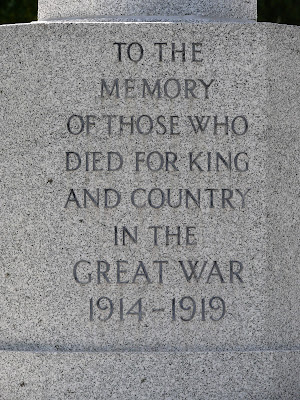
Front:

TO THE 

MEMORY

OF THOSE WHO

DIED FOR KING

AND COUNTRY

IN THE

GREAT WAR

1914 - 1919


Back:

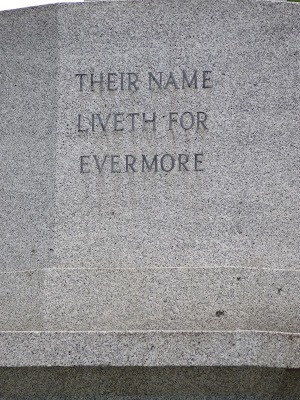
THEIR NAME

LIVETH FOR

EVERMORE


Sunday, 23 January 2022

Highgate


Location:  Chatham-Kent     N 42.50133   W -81.81704

Beside the Legion at 256 King Street South.


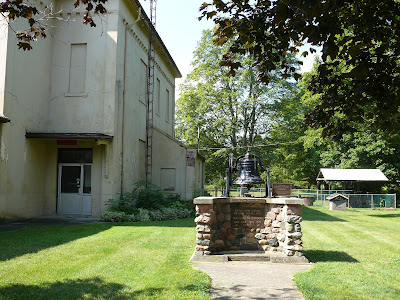
This memorial sits beside the Royal Canadian Legion Branch 335.  It is made of a curved fieldstone wall with a large bell resting on top of the wall.  The bell was made in Maryland in 1887.  A plaque is mounted at the front of the memorial and recognizes those who served in the major wars of the 20th century.  A second plaque pays tribute to the first president of this Legion branch.

Highgate is a town with a population of less than 400 people, but has all the amenities to service the neighbouring rural community.  It is located between the busy Highway 401 and the calm beaches of Lake Erie.  This small village is home to the longest running agricultural fair in Ontario, its Fall Fair being the highlight of local activities throughout the year.  The area's biggest claim to fame however, was the 1890 discovery of the most complete skeletal remains of an ancient Mastadon.  Considering the small size of this village, it truly punches above its weight and its contribution of brave heroes who served their country in time of war is certainly among its greatest achievements.


Market text:

Front plaque:

For Whom The Bells Toll


TO ALL WHO SERVED

OR GAVE THEIR LIVES

FOR

THE CAUSE OF FREEDOM

1914 - 1918     1939 - 1945

KOREA


Top plaque:

IN MEMORY OF

ALBERT & MARTHA

TEETZEL

FIRST PRESIDENT OF THE CANADIAN LEGION BR. 335

AND ALL THOSE WHO SERVED THEIR COUNTRY

A57841  CPL. W.M. CLARK