Sunday, 13 March 2022

Manotick


Location:  City of Ottawa     N 45.22724   W -75.68343

In Remembrance Park, 5517 Dickinson Street.

The Manotick Remembrance Park is found in a beautiful, historic area along the Rideau River.  The village is a small suburb of the City of Ottawa.  The memorial consists of three parts, all connected by a walking path.  

First is the cenotaph itself, the Manotick Cenotaph is composed of grey concrete and a metal plaque.  It is dedicated to the memory of men and women of the Allied Forces who made the supreme sacrifice for their country. The wrought iron fence surrounding the cenotaph was once installed at the residence of The Rt. Honourable Sir Robert Borden, Prime Minister of Canada from 1911 – 1920.

Second, is the Veterans' Walkway, which leads from the cenotaph to the historic Watson's Mill.  Veterans' Walkway is dedicated to those who served their countries in times of war, peace and peacekeeping. There is a dedication plaque at the start of the pathway of interlocking bricks and close to 200 bricks in the walkway dedicated to individual veterans or military units. 

 Finally, we have the Manotick Remembrance Park which was opened July 2, 2017 as a place to remember and to reflect on the contributions made by those who served their country in war and peace. There is statue of an old veteran holding hands with a young girl and several signs dedicated to the various branches of the Canadian Forces and to the history of the area.


**Special thanks the Louise Bellec for the photographs.


Marker text: 

Cenotaph:

In the memory of those men
and women of the Canadian and
Allied Forces, who made the
supreme sacrifice for
their country, in times of war,
peace or peacekeeping.
WE WILL REMEMBER THEM


Veterans' Walkway:

VETERANS' WAY

This walkway is dedicated
to those men & women who served
thier countries in times of
war, peace & peacekeeping.

Their names are engraved with
loving memories, respect & gratitude.

Inscriptions on individual memorial bricks:

Pipe Major Samuel Scott

R. Armstrong MC Capt RCE

LCol R.G. Ashman CH of O 1914- 1988

Raymond Lessor Nav RCAF

W. David Adlam RCAF 1941- 1945

W/C Halsmith RCAF 1941- 75

Allan Quinn CH of O (MG)

R.A. Robson RCAF WW II

W.C. Lawrence 154th WW I

George Smith 58th Bn WW I

A.F.F. Brodic 1st Devonshire

Gordon Todd RCAF 1942- 69

W. barnes Tobruk

Sgt E. Menzie 1916- 1944

Frank Turner S/Sgt APTC

Adair Vallieres RCAF Radar WW II

Cliff Keeler Cameron Highlanders

C. Richardson Capt M.D. Army

Gordon Sheppard RCAF 1939- 1945

K. Richardson Maj PLDG

Ramsay Brown 191 Sqn India

O.B. Wilson MD RCAF Radar

LCol B.B. Alger Korea 1935- 91

Barbara Fromow WAAF

W. Keith Buck Capt & Adjt

David Fromow RCA Normandy

Eldon Brownlee RCAF 1940- 1945

Denis Murray DFC 1942

W.M. Goodwin Capt RCE MC

Robert R. Read Pvt RCAF

John J. Leo Shields RCAF

William Gray F/Sgt RCAF

Keith Cheyne 1957 RCAF 1995

Jack Sawyer Burma Star

P/O J.L. Dods 233 Squadron

A.E. Armstrong PPCLI WW I

Adelbert Kelly RCAC 1939- 45

Robert S. Grant RCCS 1938- 1945

Cpl G.A. Johnson RCE 1941- 45

William L. Shaver WW I

Arthur Ellis WO1 (RSM) REME

Clifford Shaver WW I

Fred Harris RC Sigs Korea

Russell Shaver WW I

Douglas Graham RCAF 1941- 45

WO1 H.W.E. Mullalieu WW II 1939- 45

F/O J.M. Kelly 415 Squadron (Merv)

CWO D.F. Meisner- Meisner Family

R.A. Simpson F/lt RCAF

Rob Murray Bdr Juno Beach 14th FA 1941- 46

H.W. Kennedy Army SDGH

Les Vaughan Bdr Burma Star 55th AA 1940- 46

L.H. Lyall Capt RCASC

John Boucher 1939- 1945

M.A. McElroy WW I

Arthur E. Boucher 1939- 1945

2nd Division Europe 1943- 45

C.B. Maxwell WW I 1914- 18

Hugh McLeod RCAF 32 Sqn

G.A. Maxwell WW I 1914- 18

Mary Boivin WAC UK

Robert G. Flann 156 Bat WW I 1914- 18

Bill Boivin 51st Anti- Tank

A. Maxwell  WW I 1914- 18

Charles Minty WW I

Arthur Sheperd 156 Bat WW I 1914-18

Ann R. Minty RCAF (WD)

James A. Brown WW I 1914- 18

William M. Robertson WW I

Capt (Rev) T.W. Tyson WW II 1939- 45

Norman Minty RCNVR

G.A. Bradley WW I 1914- 18

J.A. Morrison RCAMC 1942- 46

Capt Charles F. Blair WW II 1939- 1945

R.A. Budd CIB 5 Div 1943- 45

Wes Sheffield WW II

Harold Watson RCAMC 1939- 45

George Owens Vimy WW I

Joseph Morin WW II 1920- 1972

Donald S. Mather Died WW I

Sydney Murphy 51st Bty WW I

John A. Mather Served WW I

Gordon Oakley Korea Vet

Claire R. Heggtvert RCAMC (Lieut)

W.R. Newton 1st Div Sigs

Francis G. Heggtvert RCAF (S/S)

F/Lt Sydney G. Pickett RCAF 1940- 1945

W.K. Buchanan RCA Italy Nav

Douglas Todd F/Sgt RCAF

K. Cavers RCNVR Atl Convoys

Pr Gordon Sheppard PP can Infantry

Walter H. Smith Rifle Brigade KIA Aug 1917 WW I

Maj R.W. Jago MC France 1914-18, Pacific 1942-45

Alvin G. Ingram F/Sgt RCAF 1942- 1963

Ernest Todd F/Sgt RCAF

Ralph L. Larkin RHA 1914- 18 WW I


S. Mansfield CFA WW I 1914- 18

Arthur Wingate 1920- 2003 RCAF WW II

Samuel Hayes 21st Bn WW I

Albert Bertsch Wehrmacht, RCAF

Hubert Stamp Sapper WW I

Lt Colonel F.R. Feeborn MC Kor/Cyp 1924- 1974

A.U. Houle DFC & Bar RCAF 1940- 1965

Major S.G. Freeborn MC COSEF 1888- 1965

Reg Falls Army 1943- 1945

Charles T. Knox RCNV & HMS WW II

John W. Gibson RCAMC 1941- 46

RQMS Les Smith RCCS 1940- 1946, 1907- 1987

Bill Fyke GGFG

Cpl A. Kenneth Collins Grd Trenton 1942- 45

Doug Hyde GGFG

Allen Ginn, CPO, WW II

Capt James W. Button US Signals 1966- 71

Ronald Knox RCNVR WW II

Sgt Ken Smith RAF 1940- 46 237 Sqd  SEAC

Major Eric Isenor WW II Korea

W.K. Buchanan RCA Italy NEW

J.W. Duthie Scott CDS/Sgt RCCS WW II

Sgt Bill VanDenBosch 1941- 1945

John C. Avery RCAF

Bill Loftus 89 Sqd RAF WW II

R.A.B. Ellis RCAF

P.B. Donovan RCAF 1945-

F/L W.G. Maund RCAF

Barbara Goodwin LAW RCAF (WD)

Potter Family, Army, RCAF

A.M. Goodwin Lt RCA

W. Edward Clapp RCAF 1943- 1946,RAF 1947- 1950

Maj G.B. Fels RCE 1939- 1945

E.R. Hubbard QOR WW 1 & 2

Clifford Ball CGR CEF 1914- 18

Tpr Sadler H., 8th Recce, B72443

Jack Johnston Killed in action 1945

D. Humphreys, F/Lt RCAF 1941- 1945

James McGlade 5 Cav Regt WW I

Edward Morton CPO RCN

Capt A Camp OBE M Navy

G.C. Riley MBE F/O RCAF 1942- 1945

Lt Col P. Camp RE, WW II, Korea

John Broadfoot MBE Capt SWAC

H. Camp RA Killed in action 1916

Evelyn Crouch CWAC

Brig J.M. Melville, CBE, MC, RCE


Capt K. Camp, M Navy, WW II


Edward Ramsdale RCAF 1942- 1946


John A. Paul Armoured Corps


Ken Cavanagh 65th Tank Transport


D.E. Good RCAF 1941- 45


LCol H.E. Good, MC, CD, RCC Signals 1939- 45


In Memoriam of Manotick Veterans


Wilf Carter, 160th Bn, WW I


J.H. Chanonhouse 13th Brigade CFA


Marian Sadokierski Polish Div, N Africa, Italy


Russell Martin Navy WW II 1944- 45


Clifton McVicar, Army, WW II 1940- 45


Raymond McCrea Army WW II 1942- 46


D.W.E. Lindsay Ord Corps 42- 45


O.D. Couvrette WW2 D Day Vet 39- 45


Roy J. Henry 49th, 73rd, 21st Battery, CFA


Cpl G. Hayes Black Watch WW II


Sgt Fred Hayes RCASC Korea


Bruce Moodie WW II 1942- 45


W/C T. Mullen RCAF 1937- 1969


Raymond Thompson RCN WW II


S/Sgt S.R. Williams L. Superior Regt WW II


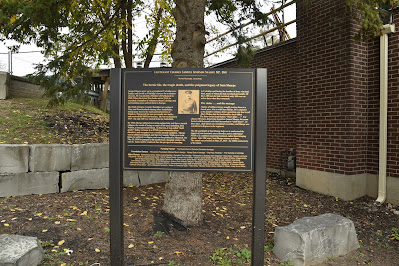
Remembrance Park:

Manotick
Remembrance Park
This is a place to remember and to reflect
with gratitude on the contributions made
by those who served their country in war
and peace.
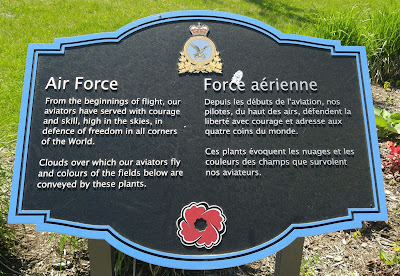
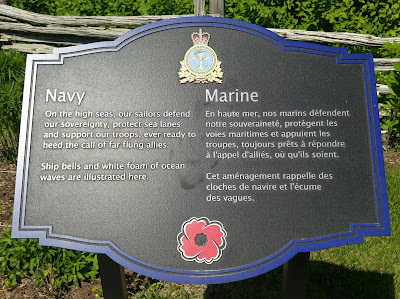
The park contains six floral gardens
dedicated to the Army, Navy, Air Force,
Merchant Navy, Peacekeeping
under a United Nations mandate,
and Homefront. Visit and enjoy.
This park contains features that make it
accessible to all users and is a partnership
between the City of Ottawa and the Royal
Canadian Legion Branch 314 (Manotick)
Opened July 2, 2017
Royal Canadian Legion
Branch 314 (Manotick)
Ottawa


Sunday, 6 March 2022

Toronto - Canadian Volunteer Monument


Location:  City of Toronto     N 43.66263   W -79.39330

On the grounds of the University of Toronto, on the west side of Queen's Park Circle.

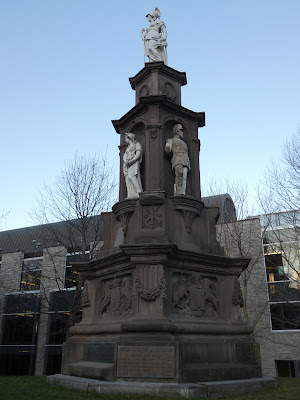
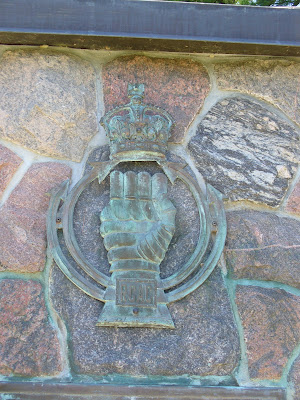
The Canadian Volunteers Monument, also called the Lime Ridge Monument, honours the Toronto militia volunteers killed in the Battle of Ridgeway on 2 June 1866. The Toronto militia volunteers were fighting Irish-American Fenian insurgents who had invaded Canada near Fort Erie in the hopes of holding Canada ransom for Irish independence. Between 1866 and 1871, this group raided Canadian territory from New Brunswick to Manitoba. Nine riflemen from Toronto’s Queen’s Own Rifles Regiment were killed, including three University of Toronto students. The entire city shut down for the funeral procession to the Necropolis.

The monument was erected by the Canadian Volunteer Monument Campaign of 1866 Committee comprised of Toronto citizens and chairman, Dr. McCaul, President of the University. The Italian Renaissance style monument of sandstone and marble was sculpted by Robert Reid of Mayor & Co. of Montreal. It was unveiled on Dominion Day 1870.

Conservation work began in October of 2006. The center beehive-shaped core was rebuilt. The masonry was cleaned, marble statuary treated, stone delamination was repaired and the most deteriorated stone blocks were treated with a moisture-permeable consolidant. Work was completed in December of 2007.

Although located on the University of Toronto campus, the monument belongs to the City of Toronto.

Three of the men named on this memorial - Private Malcolm Mackenzie, Private William F. Tempest and Private John H Mewburn, all of No. 9 Company, are also commemorated on a stained glass window in University College.


Marker text:

Front centre:

CANADIAN VOLUNTEERS MONUMENT

CAMPAIGN OF JUNE 1866

HONOUR THE BRAVE WHO DIED FOR THEIR COUNTRY 


Right plaque:

KILLED IN ACTION AT LIMERIDGE

JUNE 2nd 1866

QUEENS OWN RIFLES

ENSIGN MALCOLM McEACHREN   No. 5 COMPANY

LANCE CORPORAL MARK DEFRIES  No. 3 COMPANY

PRIVATE CHRISTOPHER ALDERSON  No. 7 COMPANY

PRIVATE WILLIAM SMITH  No. 2 COMPANY

PRIVATE MALCOLM MACKENZIE  No. 9 COMPANY


Left plaque:

KILLED IN ACTION AT LIMERIDGE

JUNE 2nd 1866

QUEENS OWN RIFLES

PRIVATE WILLIAM F TEMPEST  No. 9 COMPANY

PRIVATE JOHN H MEWBURN  No. 9 COMPANY

DIED FROM WOUNDS RECEIVED IN ACTION

SERGT. HUGH MATHESON  No. 2 COMPANY

CORPORAL FRANCIS LACKEY  No. 2 COMPANY


Rear Plaque:

CANADA ERECTED THIS MONUMENT

AS A MEMORIAL OF

HER BRAVE SONS THE VOLUNTEERS

WHO FELL AT LIMERIDGE OR

DIED FROM WOUNDS RECEIVED IN ACTION

OR FROM DISEASE CONTRACTED IN SERVICE

WHILST DEFENDING HER FRONTIER

IN JUNE 1866


Saturday, 26 February 2022

Uxbridge - Lt.-Col. Samuel Sharpe


Location:  Durham Region     N 44.10888   W -79.12300

On the northwest corner of Brock Street and Toronto Street, beside the CIBC Bank.

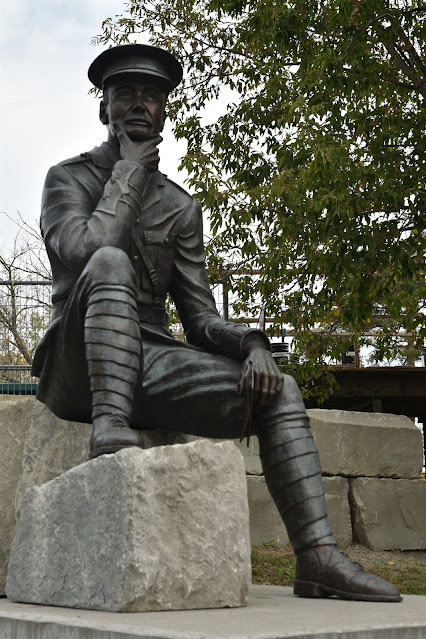
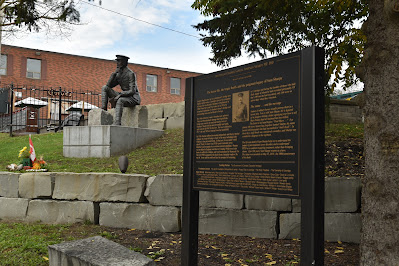
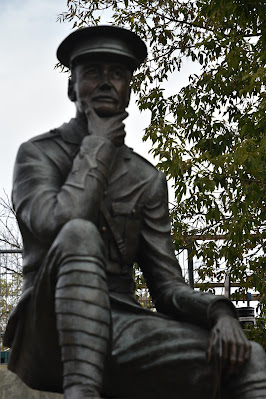
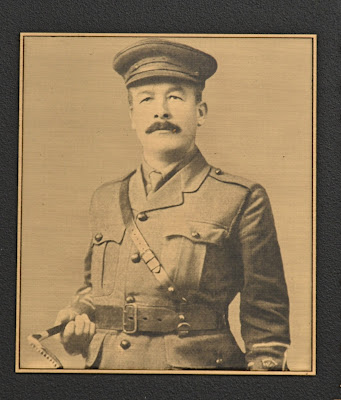
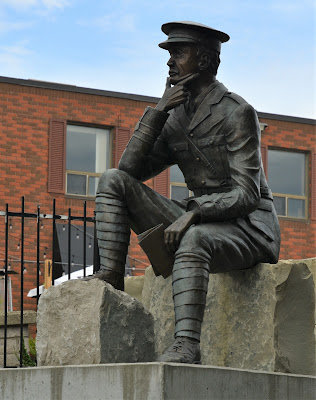
This memorial is dedicated to the tragic story of Lt. Colonel Samuel Sharpe, who was born in the nearby village of Zepher in 1873.  The statue was unveiled on May 25th, 2018 to mark the 100th anniversary of his untimely death.  The bronze statue was the creation of renowned local sculptor Wynn Walters. 

At the time of the First World War, Sharpe was serving as a Member of Parliament since the election of 1908.  He was authorized to raise the 116th Battalion (Ontario County) of the Canadian Expeditionary Force.   The Battalion arrived in England in the summer of 1916 and, following training, was deployed to the front in France in February 1917.  After suffering devastating losses Lt.-Col. Sharpe was sent home to Canada with a diagnosis of "nervous shock," a condition better know as post-traumatic stress disorder today. The celebrated soldier and sitting MP, who was awarded the Distinguished Service Order for gallantry, was virtually erased from the history books after committing suicide at his Montreal hospital it 1918. The story has been revived in recent years as a cautionary tale around the military’s past treatment of mental injuries suffered by soldiers.The Rotary Club of Uxbridge kicked off a $70,000 fundraising campaign with a donation of $10,000 to the Uxbridge-Scott Historical Society. April 24, 2017. By 2017, Uxbridge-Scott Historical Society organizers had raised nearly $50,000 of the $70,000 necessary to match a grant provided by the federal government.

The statue of Lt-Col. Sharpe is a very poignant figure staring into the streets of Uxbridge, deep in thought of the agony and death of his brave men.  The sign which accompanies this revered statue gives an excellent explanation of the shadows that haunted his mind.


Marker text:

LIEUTENANT COLONEL SAMUEL SIMPSON SHARPE MP, DSO

WYNN WALTERS, SCULPTOR


The heroic life, the tragic death, and the poignant legacy of Sam Sharpe.


Samuel Sharpe grew up in a prominent Uxbridge area family, and served as Uxbridge's lawyer for 

a number of years.  He was elected a Member of Parliament in 1908.  When the Great War broke out

in 1914, he recruited a battalion of volunteers from Uxbridge and surrounding areas and led them to Europe.

His 116th (Ontario County) Battalion saw action at Vimy and Passchendaele among other battlefields,

losing many men in the mud and barbed wire of Flanders.  Sharpe led his men personally into battle,

and received the DSO for bravery.  He was re-elected in 1917 - the only MP ever elected from the 

battlefield.

By 1918, Sharpe suffered increasing melancholy and then a mental collapse, the result of losing so many of his men, including John Walton, a close personal friend.  In that era, it was called "shell shock".  Today we know it as PTSD, (post-traumatic stress disorder), and recognize it as a serious mental condition.  Sharpe was invalided to England, and then to Canada.  While on a train home, he suffered a collapse, and was hospitalized in Montreal.  On May 25, 1918 he jumped to his death from a hospital window.  He was 46.  Some said he could not face the prospect of returning to Uxbridge and facing the families of those who had died, many of whom he had recruited personally.  Of the 1,100 men he had recruited, only 160 were on active duty when they returned.

The statue ... and the message

Statues of military heroes usually portray them in a historic pose.  Not so with Sam Sharpe.  He is depicted as he ponders writing a letter, agonizing over how to tell Mary Walton that her husband had been killed.  The letter in his hand begins:  "Dear Mary..."  For almost 100 years, history has forgotten Samuel Sharpe, his name buried with thousands who had succumbed to "shell shock".  In those days, shell shock was considered cowardice, and Sharpe was considered a disgrace to the regiment.

The life and death of Sam Sharpe helps us to understand the impact of post-traumatic stress disorder, and to understand PTSD as a condition requiring treatment, rather than bringing shame.  After 100 years, Sam Sharpe returns as a hero.  The statue was unveiled on May 25, 2018 - the 100th anniversary of his death.


Saturday, 19 February 2022

CFB Borden - Major-General Worthington


Location:  Simcoe County     N 44.28714   W -79.89158

In Worthington Park, west side of Dieppe Road.

This memorial is dedicated to the Major-General Frederic Franklin Worthington, the "Father of the Royal Canadian Armoured Corps".   "Worthy" or "Fighting Frank", as he was nicknamed, was born in 1899 in Scotland and lived a storied life of adventure until his death in 1967.  He is buried here, along with his wife Clara, at the top of the ridge that runs through Worthington Park in the heart of CFB Borden.  His military career saw him fight in the Mexican Civil War and both World Wars.  After the First World War he was a strong proponent of adopting armoured fighting vehicles.  Thanks to Worthington's determination, Canada acquired its first tanks in 1938: two Vicker light tanks, and ten more the following year.Worthington went on to become the leader of the Royal Canadian Armoured Corps, setting up training and the procurement of tanks, making CFB Borden the home of the tankers.   Worthington served as General Officer Commander in Chief of Pacific Command from 1 April 1945 to 26 January 1946. Later he was appointed the first Colonel-Commandant of the Royal Canadian Armoured Corps. 

 Worthy died on 8 December 1967 at Ottawa's Military Hospital. After his funeral in Ottawa, Worthy's body was flown by a RCAF Caribou aircraft to Camp Borden and in accordance with his wishes, was interred in Worthington Park. Four Centurion tanks fired a 13 gun salute and three RCAF Chipmunk aircraft did a low-level "fly-past", in tribute to a great soldier and Canadian. 

Today Worthington Park remains as a strong reminder of the birthplace of the Royal Canadian Armoured Corps and a tribute to its father, Frederic Franklin "Fighting Frank" "Worthy" Worthington.